Thamel, Kathmandu, Nepal





The Manaslu Circuit Trek is one of Nepal's most spectacular and rewarding Himalayan journeys — a 17-day adventure that takes you around Mount Manaslu (8,163m), the world's eighth-highest mountain, through remote valleys, ancient Buddhist villages, and dramatic alpine landscapes. Starting from just USD $560 per person, this trek offers extraordinary value for an experience that rivals the Everest and Annapurna circuits at a fraction of the crowd.
Departing from Kathmandu, the route winds through the Budhi Gandaki River valley, passing through traditional Tibetan-influenced communities such as Jagat, Lho, Samagaon, and Samdo. You'll encounter ancient monasteries, mani walls, prayer flags, and a way of life largely unchanged for centuries — offering a genuinely authentic cultural trekking experience in Nepal that is increasingly hard to find.
The undisputed highlight of the trek is the crossing of Larkya La Pass (5,160m) — one of the most dramatic and rewarding high mountain passes in the entire Himalayas. Standing at the top, surrounded by panoramic views of Manaslu, Himalchuli, Naike Peak, and Peak 29, is a moment every trekker carries with them for life.
Because the Manaslu Circuit falls within a restricted trekking zone, the trail remains far quieter than the popular Everest Base Camp or Annapurna Circuit routes. This makes it the best alternative trek in Nepal for those seeking solitude, untouched nature, and raw Himalayan beauty without the tourist crowds.
The best time to do the Manaslu Circuit Trek is during spring (March–May) and autumn (September–November). Spring brings blooming rhododendrons and vibrant green landscapes, while autumn offers crystal-clear skies and the finest mountain views of the season. Orbit Nepal Adventure runs fixed group departure dates throughout both seasons, making it easy to join a team and keep costs low.
Graded moderate to challenging, the trek is suitable for fit trekkers with some prior hiking experience. Daily walking is approximately 5–6 hours, with longer days around the pass crossing. Our experienced, government-licensed English-speaking guides handle all restricted area permits — including the Manaslu Restricted Area Permit (RAP), Manaslu Conservation Area Permit, and Annapurna Conservation Area Permit (ACAP) — so you can focus entirely on the journey.
With over 15 years of experience as a trusted Kathmandu-based trekking company, Orbit Nepal Adventure provides comprehensive support including airport transfers, teahouse accommodation, all meals during the trek, porters, down jackets, sleeping bags, and full staff insurance — ensuring a safe, seamless, and unforgettable Manaslu Circuit Trek experience.
 Accommodation:
 Hotel in Thamel
 Meals:
 Not Included
 Altitude:
 1,345m
Your Manaslu Circuit Trek adventure begins the moment you land at Tribhuvan International Airport (TIA) in Kathmandu, Nepal. An Orbit Nepal Adventure representative will be waiting for you in the arrivals hall with a welcome sign, ready to transfer you smoothly to your hotel in the vibrant Thamel district of Kathmandu.
Kathmandu, the ancient capital of Nepal, sits at an altitude of 1,345m in a broad Himalayan valley and is home to over 1.4 million people. The city is a fascinating blend of centuries-old Hindu and Buddhist heritage, bustling bazaars, colourful streets, and a thriving backpacker and trekking culture that has made it the gateway to the Himalayas for adventurers from around the world.
Your first day is intentionally kept free for rest and recovery from your long international flight. Nepal is 5 hours 45 minutes ahead of GMT, so jet lag can be significant depending on where you're travelling from. Use the afternoon to rehydrate, have a light meal, and begin acclimatising to the altitude.
In the evening, you're free to explore the lively streets of Thamel — Kathmandu's famous traveller district packed with trekking gear shops, local restaurants, rooftop cafes, and souvenir markets. Your trek briefing and gear check will take place the following day, so tonight is simply about settling in.
Altitude note: At 1,345m, Kathmandu is well within the comfortable range for most travellers. No altitude concerns on Day 1.
Accommodation: Hotel in Thamel
Meals: Breakfast Included
Altitude: 1,345m
Day 2 is a full and productive day in Kathmandu combining essential trek preparation with a guided cultural sightseeing tour of the Kathmandu Valley — a UNESCO World Heritage Site of exceptional significance.
Morning — Kathmandu Valley Sightseeing Tour
Your guide will take you on a half-day cultural tour visiting three of Kathmandu's most iconic UNESCO World Heritage Sites:
Afternoon — Trek Briefing & Gear Check
Back at the hotel, your Orbit Nepal Adventure trek leader will conduct a thorough briefing covering:
This afternoon is also your last chance to purchase any missing trekking equipment in Thamel before heading into the mountains. Thamel has excellent gear shops stocking everything from North Face and Mammut to high-quality local brands at competitive prices.
Altitude note: Still at 1,345m — no concerns.
Accommodation: Teahouse / Local Lodge
Meals: Breakfast, Lunch, Dinner
Altitude: 700m
Today marks the true start of your Manaslu Circuit Trek adventure as you leave the capital behind and head deep into the rural heartland of Nepal. After an early breakfast, your private jeep or bus departs Kathmandu and heads west along the Prithvi Highway through the Trishuli Valley before turning north towards the Gorkha district.
The drive to Arughat Bazaar takes approximately 6–8 hours depending on road conditions and is a scenic journey in its own right, passing through terraced rice and mustard fields, riverside villages, and increasingly dramatic hill country. The road quality deteriorates significantly in the final stretches before Arughat, but this is part of the adventure — a preview of the remote terrain you'll be trekking through over the coming two weeks.
Arughat Bazaar is a bustling market town on the bank of the Budhi Gandaki River — the river that will be your constant companion for the first week of the trek. Sitting at just 700m altitude, Arughat has a warm, humid climate and a lively local market atmosphere. It serves as the administrative and commercial hub for the surrounding Gorkha villages and is where your trekking permits will be checked for the first time at the checkpoint here.
Spend the evening exploring the local market, trying your first teahouse dinner of the trek — typically dal bhat, the classic Nepali meal of lentil soup, steamed rice, vegetable curries, and pickles — and getting an early night in preparation for your first full trekking day tomorrow.
Altitude note: You descend significantly from Kathmandu to 700m today, which is a good thing for acclimatisation purposes.
Accommodation: Teahouse / Local Lodge
Meals: Breakfast, lunch, dinner
Altitude: 869 m
The trek officially begins today! After an early breakfast at your lodge in Arughat, you set off on foot along the west bank of the Budhi Gandaki River, the river whose course you will follow northward for the next several days as you climb deeper into the Manaslu massif.
Today's trail is a gentle and welcoming introduction to trekking in Nepal. The route passes through classic lower Himalayan terrain: lush subtropical forests of sal and bamboo, terraced farmland with paddy and millet, and small riverside hamlets where local villagers go about their daily lives largely unchanged from centuries past. Children wave and call "Namaste!" from doorways, farmers work their fields with hand tools, and the sound of the rushing Budhi Gandaki fills the valley.
You'll cross several suspension bridges over the river during the day — the first of many dozens you'll encounter on this trek. The bridges vary from solid steel structures to swaying bamboo-and-wood constructions that add a certain thrilling element to the walk.
The trail passes through the villages of Arkhet and Kyorpani before reaching Machha Khola ("Fish River" in Nepali), a small village sitting at the confluence of the Budhi Gandaki and a smaller tributary stream. Teahouses here are simple but clean, offering hot meals and basic dormitory-style rooms.
Today's trekking stats: Approximately 18–20km | Elevation gain: ~170m | 5–6 hours walking
Accommodation: Teahouse
Meals: Breakfast, Lunch, Dinner
Altitude: 1,340 m
Today the trail begins to feel more distinctly Himalayan as you continue northward along the Budhi Gandaki River, climbing gradually through increasingly dramatic gorge scenery. The vegetation transitions from subtropical lowland forest to mixed temperate woodland, and the river narrows between towering rock walls in several places, creating spectacular canyon-like passages.
Leaving Machha Khola, the trail passes through Khorlabesi, a small village famous for its Tatopani hot springs — a highly welcome opportunity to soak tired feet and muscles in naturally heated mineral water. If you have time during lunch, a dip in the hot springs is well worth it and a favourite stop for trekkers on this route.
The trail continues through Dobhan, a slightly larger settlement with teahouses and a checkpoint, before making a final steady climb to Jagat — an important milestone on the Manaslu Circuit Trek. Jagat is the official entry point of the Manaslu Conservation Area and the location of the main permit checkpoint where your Manaslu Conservation Area Permit (MCAP) will be verified. The village itself is attractively built with traditional stone houses and slate-roofed teahouses lining the main trail.
From Jagat, the character of the trek changes noticeably — the lower-altitude subtropical landscape gives way to more mountainous scenery, and the trail enters the restricted area where the real adventure begins.
Today's trekking stats: Approximately 17km | Elevation gain: ~470m | 6–7 hours walking
Accommodation: Teahouse
Meals: Breakfast, lunch, dinner
Altitude: 1,950 m
Departing Jagat after breakfast, today's trek enters increasingly dramatic gorge terrain as the Budhi Gandaki River cuts its way through ancient metamorphic rock formations. The trail climbs steadily through terraced fields, stone steps worn smooth by generations of feet, and small villages where Gurung and Tibetan-influenced communities maintain traditional mountain livelihoods.
A highlight of today's route is passing through Philim — a large and beautiful Gurung village with wide paved trails, traditional stone architecture, and sweeping views across the valley. Philim is one of the most photogenic settlements on the lower Manaslu Circuit and a great place to pause for tea and observe authentic local Gurung culture. The Gurung people, one of Nepal's celebrated hill tribes, have historically served in the Gurkha regiments of the British and Indian armies and have a proud warrior tradition alongside their agricultural and herding lifestyle.
Beyond Philim the trail narrows and enters a tighter section of the valley, with waterfalls cascading down the cliffs from unseen heights and pine trees beginning to appear alongside the rhododendron and oak. The atmosphere becomes noticeably wilder and more remote.
After approximately 16km of walking, you arrive at Nyak (also spelled Ngyak), a peaceful high-altitude village with basic but comfortable teahouse accommodation, mountain views, and the satisfying sense of having moved genuinely deep into the Himalayan world.
Today's trekking stats: Approximately 16km | Elevation gain: ~610m | 6–7 hours walking
Accommodation: Teahouse | Meals: Breakfast, Lunch, Dinner
After breakfast at around 7am, today's trek takes you through one of the most spectacular gorge sections of the entire Manaslu Circuit as the Budhi Gandaki River carves its way through a dramatic narrow canyon flanked by towering walls of dark rock. Waterfalls plunge from the cliffs above, and the sound of the river fills the gorge with a constant roar that makes the landscape feel both powerful and primordial.
The trail passes through the villages of Salleri, Pewa, and Deng — each offering teahouses for rest and refreshment. Deng is a particularly pleasant stop with a traditional feel and good mountain views from its elevated position above the river.
You'll cross several suspension bridges over the Budhi Gandaki during today's walk, each offering a different perspective on the swirling green river below. The trail climbs and descends repeatedly as it navigates the cliff-edged gorge, requiring good footwork and concentration on some sections.
As you approach Ghap, the valley begins to widen slightly and the trail enters dense pine and rhododendron forest that in spring months (March–April) erupts in spectacular pink, red, and white blooms. Ghap itself is a traditional village rich in Buddhist cultural markers — mani walls (long stone walls carved with the mantra Om Mani Padme Hum), prayer wheels that devotees spin as they walk past, and the first chortens (Buddhist stupas) that signal your entry into the Tibetan cultural sphere that will dominate the upper sections of the Manaslu Circuit.
Today's trekking stats: Approximately 15km | Elevation gain: ~210m | 6–7 hours walking
Accommodation: Teahouse
Meals: Breakfast, Lunch, Dinner
Altitude: 2050 m
After Breakfast at around 7 am we walk through a beautiful narrow gorge with waterfalls and dramatic cliffs. with passing the village Pewa and Deng, both offering tea houses for rest. we will also Cross several suspension bridges over the Budhi Gandaki River.The trail enters dense pine and rhododendron forest near Ghap. After walking about 15km we will arrive at Ghap. Ghap is a traditional village with Mani walls, prayer wheels, and cozy lodges.
Accommodation: Teahouse
Meals: Breakfast, Lunch, Dinner
Altitude: 3,530 m
After the exertions of yesterday's big climb, today is a shorter and more relaxed day — a welcome easy trek through some of the most scenic high-altitude landscape on the entire Manaslu Circuit. The trail from Lho to Samagaon is a gentle, gradually ascending walk through open yak pastures, birch and juniper woodland, and wide valley floors with utterly magnificent mountain views in every direction.
The route passes through Shyala village (3,500m), a small but charming Tibetan-style settlement with whitewashed stone houses, prayer flag poles, and some of the best panoramic views of the entire trek. From Shyala on a clear day you can see Mount Manaslu (8,163m), Himalchuli (7,893m), Peak 29 / Ngadi Chuli (7,871m), Naike Peak, and several other massive summits simultaneously — a truly extraordinary mountain panorama that justifies every metre of altitude you have gained to reach this point.
After approximately 9km of walking, you arrive at Samagaon (also known as Sama Gaun), the largest and most important village on the Manaslu Circuit. Samagaon is a beautiful high-altitude settlement of traditional Tibetan-style stone houses, a colourful monastery, and a warm, welcoming community of Nubri people — a Tibetan ethnic group who have lived in this remote valley for centuries, maintaining their distinctive language, dress, customs, and Buddhist faith largely unchanged from their Tibetan origins.
Samagaon serves as the primary acclimatisation stop on the Manaslu Circuit. With the Larkya La Pass crossing (5,160m) still several days ahead, spending time at 3,530m is essential for allowing your body to adapt to the altitude before continuing to climb. The Pungyen Monastery above Samagaon is well worth a visit — a 2–3 hour round-trip hike that takes you higher for better acclimatisation and rewards you with close views of the Manaslu North Face.
Today's trekking stats: Approximately 9km | Elevation gain: ~350m | 4–5 hours walking
Accommodation: Teahouse
Meals: Breakfast, Lunch, Dinner
This day trek is a gentle and scenic trail with gradual ascent. passing through Shyala Village, offering panoramic views of Manaslu, Himalchuli, Peak 29, and other high peaks. we will Walk through forests, yak pastures, and wide open valleys. After walking approx 9 km we get into the samagaon . Samagaon is a beautiful high-altitude village and a common acclimatization stop with views of Manaslu North Face and you’ll see mani walls, chortens, and traditional stone houses.
Accommodation: Teahouse
Meals: Breakfast, Lunch, Dinner
Altitude: 3,860 m
Today is one of the shorter and easier trekking days on the itinerary — a deliberately gentle stage designed to maximise acclimatisation before the high-altitude section that lies ahead. The trail from Samagaon to Samdo follows a relatively easy route through open landscape with outstanding mountain views, covering only about 6km in 3–4 hours of walking.
The path climbs gradually through sparse alpine vegetation — low juniper scrub, hardy grasses, and seasonal wildflowers in the warmer months — with the towering Manaslu massif dominating the skyline to the north and east. You'll pass through yak pastures where herders from Samagaon and Samdo graze their animals during the summer months, and the trail is wide and well-marked throughout.
Samdo (3,860m) is a small but important settlement — the last significantly sized village before the high-altitude section of the trek. The village has a distinctive frontier-outpost atmosphere; it sits just below the ridge that forms the border with Tibet, and on a clear day you can look northward across the high plateau into Chinese territory. A small Nepali Army checkpoint operates in Samdo where your restricted area permit will be verified once more.
Samdo has good teahouse accommodation with warm dining areas heated by yak-dung stoves — genuinely welcome at this altitude where evenings can drop well below freezing even in the spring and autumn trekking seasons. Use your afternoon in Samdo to rest, hydrate well, eat a large and nutritious dinner, and prepare your gear for the days ahead.
Today's trekking stats: Approximately 6km | Elevation gain: ~330m | 3–4 hours walking
Accommodation: Teahouse (basic high-altitude lodge)
Meals: Breakfast, Lunch, Dinner
Altitude: 4,460 m
Today you make the final approach to the base of the Larkya La Pass, climbing from Samdo up to the high camp at Dharmashala (also known as Larkya Phedi, meaning "foot of Larkya"). This is a moderate day of trekking in terms of distance — approximately 8km — but the altitude gain of around 600m at over 4,000m altitude makes it feel considerably more demanding than those numbers suggest.
From Samdo the trail ascends steadily through increasingly barren alpine terrain. The forest has long since been left behind, replaced by rocky moraines, glacial streams, and the stark, windswept landscape of the high Himalaya. The Budhi Gandaki River has shrunk to a braided glacial stream fed by snowmelt, and the air has a thin, crystalline quality that makes every breath feel slightly insufficient.
The route passes between massive glacial valleys with tremendous mountain walls on both sides. You'll have clear views of Manaslu North (7,157m), Naike Peak, and the Larkya Himal as you approach Dharmashala, and you may be able to see the outline of the Larkya La Pass itself on the ridge high above — the goal of tomorrow's epic day.
Dharmashala is a collection of basic but functional high-altitude teahouses clustered at 4,460m. Accommodation is simple — shared dormitories or basic private rooms — and conditions are cold and stark. However, the location feels genuinely dramatic and the community of trekkers preparing for tomorrow's pass crossing creates a lively, excited atmosphere reminiscent of a base camp before a summit attempt.
Arrive as early in the afternoon as possible, eat a large carbohydrate-heavy dinner, drink plenty of water, lay out your warmest layers ready for the early start tomorrow, and get to sleep early. Tomorrow will be the biggest day of the trek.
Today's trekking stats: Approximately 8km | Elevation gain: ~600m | 4–5 hours walking
Accommodation: Teahouse
Meals: Breakfast, Lunch, Dinner
Altitude: 4,460 m
Today is a designated rest and acclimatisation day at Dharmashala — an essential pause before the Larkya La Pass crossing that allows your body the time it needs to adapt to the thin air at 4,460m altitude. Skipping this acclimatisation day is not recommended; arriving at the pass crossing well-rested and well-acclimatised significantly reduces the risk of altitude sickness and makes the experience far more enjoyable.
The day is yours to spend as you please, but your guide will recommend a short acclimatisation hike of 1–2 hours in the morning — climbing to a higher viewpoint above Dharmashala before descending back to sleep at the same altitude. This "climb high, sleep low" approach is the most effective method of acclimatisation and is standard practice on all serious Himalayan treks and expeditions.
What to do on your rest day at Dharmashala:
Altitude awareness: At 4,460m, common symptoms of mild altitude sickness (headache, fatigue, reduced appetite, disrupted sleep) are normal. Alert your guide immediately if you experience more serious symptoms such as confusion, loss of coordination, chest tightness, or persistent vomiting.
Accommodation: Teahouse
Meals: Breakfast, Lunch, Dinner
Altitude: 5,160 m
This is the most challenging, most spectacular, and most memorable day of the entire Manaslu Circuit Trek.
Your alarm goes off at approximately 3:30–4:00am. By 4:30am, after a quick hot breakfast of porridge, tea, and bread, you are already moving — headlamps cutting through the pre-dawn darkness as you begin the long ascent to Larkya La Pass (5,160m).
The ascent to Larkya La (approximately 4–5 hours)
The trail climbs steeply from Dharmashala through a combination of rocky moraine, glacial debris, and snow-covered slopes. The pace is slow and deliberate — your guide will set a measured rhythm, reminding you to breathe deeply and steadily at this extreme altitude. The cold is intense in the pre-dawn hours, with temperatures typically ranging from -10°C to -20°C at the pass, so all your warmest layers are on and moving generates the only warmth available.
As you gain altitude, the horizon gradually brightens — first a deep blue, then a glowing orange and pink as the sun approaches the high ridgeline to the east. By the time you reach the upper section of the pass, the Himalayan sunrise is happening around you in all its extraordinary glory, with the massive snow peaks catching the first golden light of morning while the valleys below remain in deep shadow. This is one of the most stunning light shows on earth.
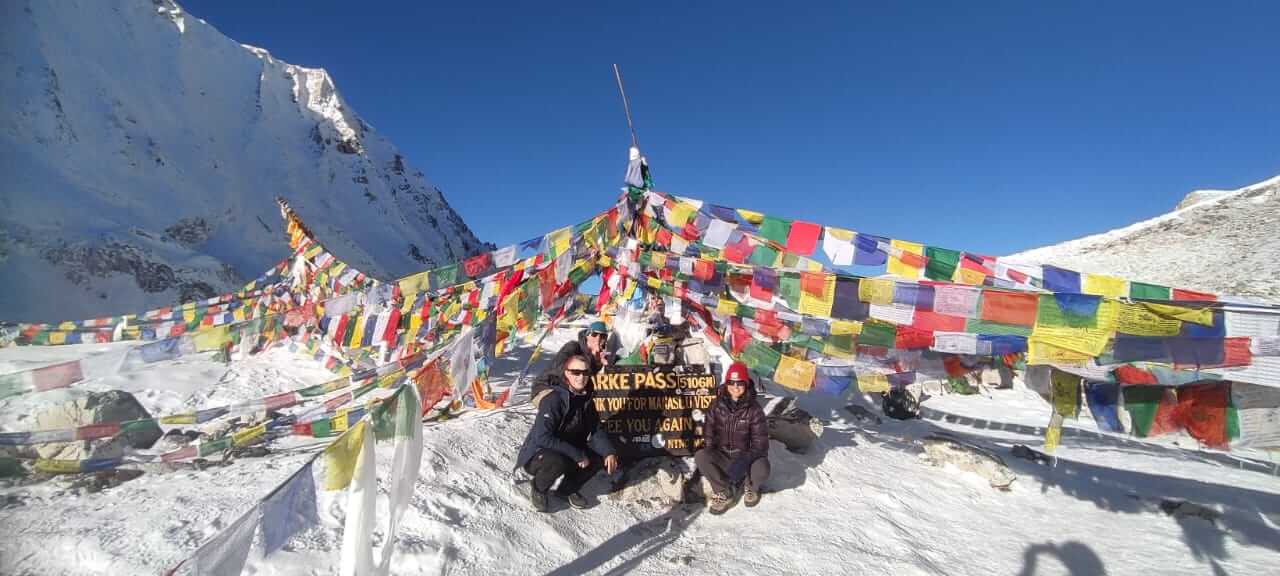
The Larkya La Pass (5,160m) itself is marked with an enormous array of colourful Buddhist prayer flags strung between stone cairns — a joyful, windswept celebration of the achievement of every trekker who reaches this point. The views from the pass are simply astonishing: to the south, the way you have come, valley after valley receding into the haze; to the north and west, a vast panorama of some of the highest mountains on earth including Cho Danda, Himlung Himal (7,126m), Cheo Himal (6,820m), Kang Guru (6,981m), and Annapurna II (7,937m).
Take photographs, offer your prayers at the cairns, hug your trekking companions, and savour this extraordinary moment — you are standing at one of the great mountain passes of the Himalayas, and you earned every metre of altitude beneath your boots.
The descent to Bhimtang (approximately 4–5 hours)
The descent from Larkya La to Bhimtang is long, steep in places, and requires concentration and careful footwork, particularly on any icy or snow-covered sections. The trail drops approximately 1,270 vertical metres over several kilometres, passing through open glacial valleys, rocky moraine fields, and eventually entering the gentler green landscape of the Dudh Khola valley.
Bhimtang (3,720m) is a wide, flat glacial meadow that transforms into a yak pasture in the summer months and a popular trekkers' camp in spring and autumn. The teahouses here are some of the most welcoming on the entire circuit — after your 9–10 hour day, a warm meal, a hot drink, and a comfortable bed feel like the greatest luxuries imaginable.
Today's trekking stats: Approximately 18–20km | Maximum altitude: 5,160m | 9–10 hours walking | Early start required
Accommodation: Teahouse
Meals: Breakfast, Lunch, Dinner
Altitude: 2,300 m
After the epic exertions of the Larkya La Pass crossing, today begins the long and satisfying descent back towards the lower valley, with your boots now pointed towards the conclusion of the Manaslu Circuit. The trail from Bhimtang to Tilje descends approximately 1,400 vertical metres through wonderfully varied and beautiful landscape.
From Bhimtang, the path drops through open glacial meadows and birch woodland before entering the dense pine and rhododendron forests of the mid-altitude Dudh Khola valley. In spring months (March–April) this section is particularly spectacular, with rhododendron trees in full bloom creating a tunnel of deep pink, red, and white flowers that is one of the most beautiful natural spectacles in Nepal.
The trail passes through the villages of Hampuk and Kharche before reaching the traditional lower-valley settlement of Tilje (2,300m). Tilje is a prosperous-looking village with well-maintained stone houses and terraced fields, and the noticeably warmer air at this lower altitude after days at 4,000m+ feels extraordinarily pleasant. Your lungs will thank you for every extra percentage of oxygen in the air.
Use your evening in Tilje to rest, enjoy a warm dinner, and reflect on what you've achieved over the past two weeks. The hardest parts of the trek are now behind you.
Today's trekking stats: Approximately 16km | Elevation loss: ~1,420m | 6–7 hours walking
Accommodation: Teahouse
Meals: Breakfast, lunch, Dinner
Altitude: 760 m
The final day of trekking on the Manaslu Circuit brings you down to the road-head at Dharapani and then by jeep or local bus to Besisahar (760m), the district headquarters of Lamjung and the official end point of the trek.
From Tilje, the trail descends through terraced farmland and forested hillsides along the Marsyangdi River valley, passing through the villages of Dharapani and Thonje — both of which have checkpoint facilities where your ACAP permit will be verified one final time. The lower valley has a lush, tropical feel that feels almost shockingly green after the high-altitude austerity of the past several days.
At Dharapani you join the Annapurna Circuit Road, and from here your trek technically ends as you board a jeep for the remaining distance to Besisahar. The jeep ride passes through beautiful river valley scenery and terraced hill villages, offering a comfortable and scenic conclusion to your epic circuit.
Besisahar is a lively town with good hotel accommodation, restaurants, and the sense of civilisation returning after two weeks in the mountains. Enjoy a celebratory dinner with your guide and porters — this is the traditional moment to offer tips to your trekking team in recognition of their hard work, expertise, and good company throughout the journey.
Today's trekking/driving stats: Approximately 10km trekking + jeep ride | 5–6 hours total
Accommodation: Hotel in Thamel
Meals: Breakfast, Lunch, Dinner
Altitude: 1,345 m
After breakfast in Besisahar, your private vehicle departs for the return drive to Kathmandu — a journey of approximately 6–7 hours through the beautiful Trishuli and Prithvi Highway corridor. The drive offers a chance to decompress, sleep, look back through your photos, and begin processing the extraordinary experience of the past two weeks.
Arriving back in Kathmandu in the afternoon, you'll be transferred to your hotel in Thamel. The evening is free for a hot shower, fresh clothes, a cold drink, and the Orbit Nepal Adventure farewell dinner — a celebration of your achievement with your guide and any fellow trekkers from your group.
Thamel in the evening after a long trek feels like the most exciting city on earth — every restaurant looks tempting, every beer tastes extraordinary, and the buzz of the traveller district matches the euphoric feeling of having completed one of Nepal's greatest treks.
Meals: Breakfast
Altitude: 1,345 m
Your Manaslu Circuit Trek adventure draws to a close today. After a final breakfast at your hotel, your Orbit Nepal Adventure representative will transfer you to Tribhuvan International Airport — arriving at least 3 hours before your scheduled departure as recommended for international flights from Kathmandu.
As you fly out over the Himalayan range — perhaps catching a final glimpse of Mount Manaslu and the great peaks you've trekked around — you'll carry with you memories of one of the world's great mountain adventures: 17 days, 160+ kilometres of trail, a 5,160m pass, ancient Buddhist monasteries, remote Himalayan villages, and the extraordinary beauty of Nepal's Manaslu Conservation Area.
Safe travels, and thank you for trekking with Orbit Nepal Adventure.
Trek Difficulty & Fitness Requirements The Manaslu Circuit Trek is rated moderate to challenging and is best suited for trekkers who are physically fit and have some prior trekking or hiking experience. The trek involves daily walks of 5–10 hours, significant elevation gain, and the high-altitude crossing of Larkya La Pass at 5,160m. We recommend at least 3–4 months of preparation including cardio training, hill walking, and building core strength. Fit beginners who train consistently can complete this trek successfully.
Best Season for Manaslu Circuit Trek The two ideal trekking windows are:
Trekking during the monsoon (June–August) is not recommended due to heavy rainfall, leeches, and slippery trails. Winter (December–February) treks are possible but cold and demanding.
Required Permits for Manaslu Circuit Trek As a restricted trekking area, the Manaslu Circuit requires three separate permits: the Manaslu Restricted Area Permit (RAP), the Manaslu Conservation Area Permit (MCAP), and the Annapurna Conservation Area Permit (ACAP). Trekking with a registered agency and licensed guide is mandatory by Nepal government regulation. Orbit Nepal Adventure handles all permit arrangements on your behalf — no extra hassle, no hidden costs.
Accommodation & Meals on the Trek Throughout the trek, accommodation is in local teahouses and basic lodges — twin-sharing rooms with simple but comfortable bedding. Meals are hearty and filling, typically including dal bhat, pasta, noodles, soups, and eggs. All breakfast, lunch, and dinner during trekking days are included in our package. In Kathmandu, accommodation is in a comfortable hotel on a bed-and-breakfast basis.
Altitude & Acclimatization The highest point of the Manaslu Circuit Trek is Larkya La Pass at 5,160m (16,929 ft). Proper acclimatization is built into the itinerary, including a rest day at Dharmashala before the pass crossing. Trekkers should be aware of symptoms of Acute Mountain Sickness (AMS) and communicate openly with their guide. Our guides are trained in altitude safety and first aid.
Packing Essentials Key items to bring include: sturdy waterproof trekking boots, thermal base layers, a warm fleece and down jacket (provided by us if needed), trekking poles, rain cover/poncho, sunscreen (SPF 50+), a quality headlamp, water purification tablets or a filter, and a personal first aid kit. A detailed packing list will be shared after booking.
Why Trek with Orbit Nepal Adventure? Orbit Nepal Adventure is a government-registered, locally operated trekking company based in Thamel, Kathmandu, with over 15 years of expertise in Nepal's Himalayan treks. Our Manaslu Circuit Trek 2026 package at USD $560 is among the most competitive and transparent in the industry — no hidden fees, no shortcuts on safety. We assign experienced English-speaking licensed guides, trained porters, and provide all essential gear including down jackets and sleeping bags. Our trekkers consistently rate us highly for reliability, honesty, and genuine care throughout the journey.





The Manaslu Circuit Trek is graded as moderate to challenging. It involves long walking days (5–10 hours), steep ascents and descents, and high altitude, with the biggest challenge being the crossing of Larkya La Pass (5,160m). Good physical fitness is essential, but with proper acclimatization and a well-paced itinerary, it is very doable. We recommend at least 3–4 months of preparation including cardio and hill walking.
Our standard Manaslu Circuit Trek 2026 package is 17 days (including arrival/departure days in Kathmandu). The actual trekking duration is 14–15 days. This includes sufficient acclimatization before crossing Larkya La Pass. We can also customize it to 14, 16, or 18 days based on your fitness and schedule.
The best time for Manaslu Circuit Trek 2026 is Spring (March to May) and Autumn (September to November).
Yes. Because it is a restricted area, you need three permits: Manaslu Restricted Area Permit (RAP), Manaslu Conservation Area Permit, and Annapurna Conservation Area Permit (ACAP). We handle all permits for you, so you don’t have to worry about the process or extra costs.
Yes, a licensed guide is mandatory for the Manaslu Circuit Trek due to the restricted area rules. Trekking with an experienced local guide is also much safer, especially for altitude management and navigation on remote trails. All our packages include a professional English-speaking guide + assistant guides when needed.
Fit beginners can successfully complete the Manaslu Circuit Trek if they are in good physical condition and follow a proper acclimatization schedule. It is more challenging than Annapurna Base Camp but less crowded. We recommend previous trekking experience or at least regular hiking practice before attempting it.
The highest point is Larkya La Pass at 5,160 meters (16,929 feet). This dramatic pass offers stunning panoramic views of Mount Manaslu and surrounding peaks. Day 13 of our itinerary is dedicated to crossing this pass — it is the highlight of the entire Manaslu Circuit Trek.
The trek usually offers teahouse accommodation, which means basic local lodges along the route with simple rooms and meals.
Essential items include good trekking boots, warm down jacket, trekking poles, rain cover, sleeping bag (we provide one if needed), thermal layers, sunscreen, hat, gloves, water purification tablets, and a headlamp. We will send you a detailed Manaslu Trek packing list after booking.
We offer one of the most affordable yet reliable Manaslu Trek packages in 2026 at just USD $560 per person (group joining). As a local Kathmandu-based company with over 15 years of experience, we provide experienced guides, proper safety measures, transparent pricing, and excellent support. Many of our clients highly recommend us for our honest service and value for money.
It was an amazing adventure to do the Manaslu trek, thanks to our guide Hari!!
In the beginning, we had some troubles with the weather and he managed it perfectly. We want to do more treks with Hari, he was friendly, funny and he did everything for us to have a good Manaslu experience.
Thank you Hari!! 🙏🏼
The company was very good as well, they gave us sleeping bags, crampons,…, all the stuff we didn’t bring. We definitely recommend Orbit Nepal!!

Had a wonderful time hiking through the manaslu region, our guide harry was extremely knowledgeable of the area and made sure we were content and safe at all times. Would absolutely recommend to anyone seeking some adventure through the Himalayas ! Thanks again 🙏